Ecommerce website development for The Scoop Plug followed two phases, with an interim upgrade supporting ongoing operations while the final store was developed. In the laboratory measurements supplied for the project, dated 22 October 2026, the final version achieved performance scores of 96/100 on mobile and 99/100 on desktop.
- The first phase addressed the immediate need for an upgrade while the final store was being developed.
- The second phase introduced a refreshed visual identity and a reorganized homepage.
- Performance scores increased from 60 to 96 on mobile and from 71 to 99 on desktop.
- Mobile LCP fell from 8.0 to 2.0 seconds in the recorded laboratory tests.
Ecommerce website development for The Scoop Plug began with a practical challenge. The sports nutrition and supplements business needed an immediate improvement to its online presence while continuing to operate. Wechevo organized the project into two phases, separating the interim solution from the development of the final store.
Why choose ecommerce website development in two phases?
The two-phase approach addressed immediate operational needs while allowing time for the final development. Each stage had a different purpose and level of completion.
Business continuity is a company’s ability to maintain its essential activities while managing changes or disruptions.
According to the project description, The Scoop Plug’s original website no longer met the business’s needs. An interim solution was required to support operations while the broader redesign progressed.
The temporary upgrade served that purpose. The final version formed a separate stage, introducing a refreshed presentation and stronger laboratory performance.
For a business considering ecommerce website development, the project illustrates the importance of planning. Immediate needs and longer-term goals can be addressed through successive, clearly defined stages.
What did the interim upgrade achieve?
The interim version allowed the business to continue operating during the development of the final solution. It was an intermediate stage with a specific business purpose.
In ecommerce website development, this approach needs clear boundaries. The team should understand which needs are being addressed immediately and which tasks belong to the final release.
The project’s methodology can be described in three steps.
- Address the immediate need. An interim upgrade was implemented to support the store’s operations.
- Develop the final version. Work progressed on the new storefront and a different homepage structure.
- Compare technical performance. Laboratory measurements were recorded for the interim and final versions on mobile and desktop.
The interim solution should therefore be evaluated against its intended purpose. Its lower performance scores provide the baseline for comparison without negating its role in the transition.
The supplied information does not include a detailed availability log. Operational continuity is therefore not presented here as a measured guarantee of zero downtime.
How did The Scoop Plug’s presentation change?
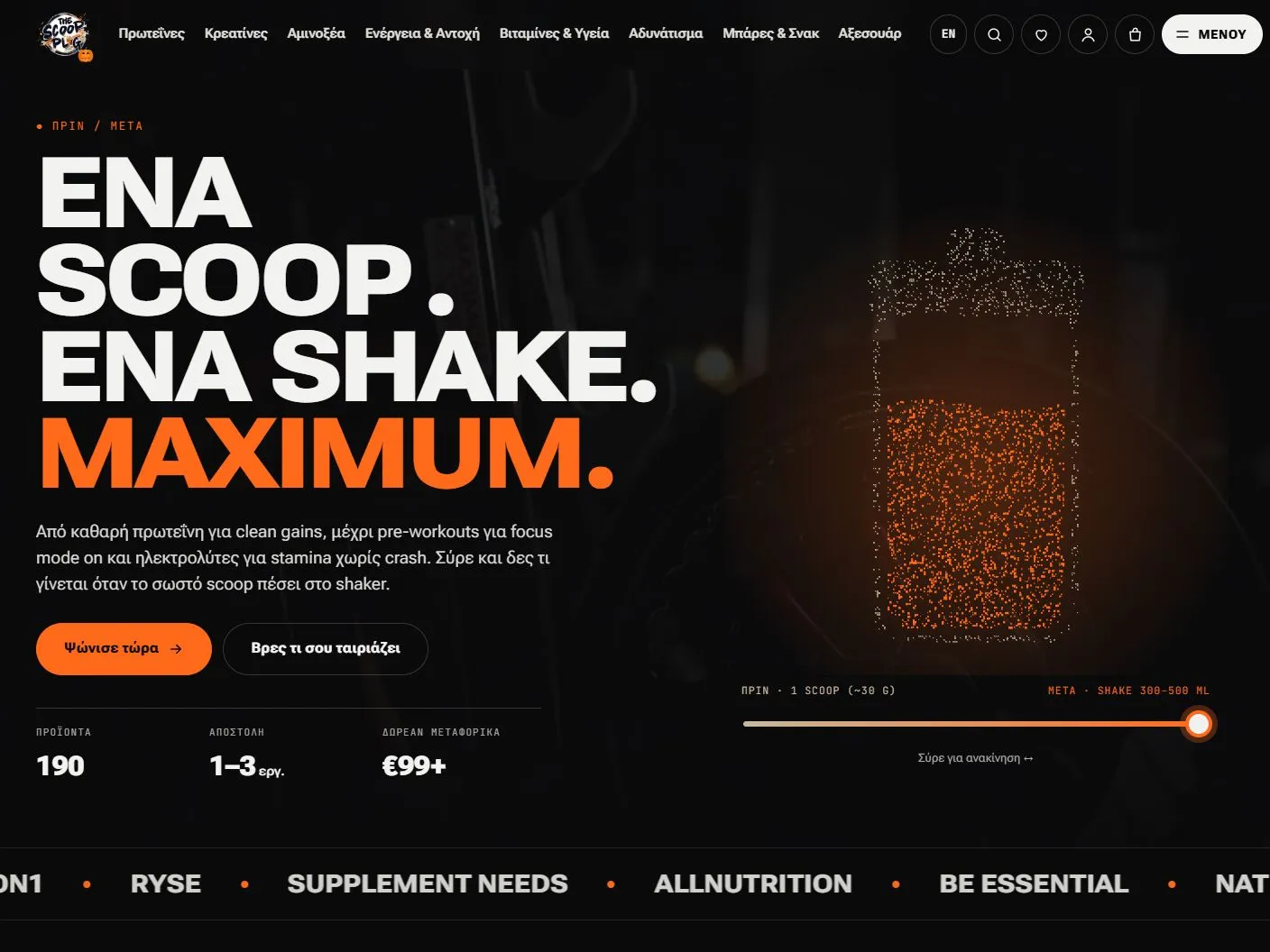
The final version was organized around product categories, brands and visitor goals. Its homepage combined a distinctive visual identity with different starting points for exploring the catalogue.
In the supplied screenshot, a black background, white typography and orange accents create a recognizable appearance. The main message is accompanied by two choices, one for immediate shopping and another for finding a suitable product.
The navigation displays categories including proteins, creatine, amino acids and accessories. The presentation also includes brands and a visual composition built around a scoop and shaker.
The ecommerce redesign, as described in the project, included adaptation for mobile and desktop devices. The screenshot documents the appearance of that particular view; assessing usability requires testing on the corresponding devices.
Ecommerce website design should support visitors who already know what they want and those who need guidance. The new structure accommodates both routes, although the design alone does not establish an increase in sales.
What did the performance measurements show?
The project figures dated 22 October 2026 show higher performance scores and lower LCP times for the final version. The comparison is between the interim and final releases, rather than the original website before any intervention.
The following PageSpeed Insights values were supplied for this case study. They are not the result of a new independent test conducted for this article.
| Measurement | Interim version | Final version | Change |
|---|---|---|---|
| Mobile performance | 60/100 | 96/100 | +36 points |
| Desktop performance | 71/100 | 99/100 | +28 points |
| Mobile LCP | 8.0 seconds | 2.0 seconds | 75% reduction |
| Desktop LCP | 1.6 seconds | 0.4 seconds | 75% reduction |
| Mobile TBT | Not supplied | 0 ms | Cannot be calculated |
| Desktop TBT | Not supplied | 0 ms | Cannot be calculated |
| Mobile CLS | 0.002 | 0 | Reduction of 0.002 |
Largest Contentful Paint, or LCP, measures the time until the largest visible content element appears within the viewport. On mobile, the change from 8.0 to 2.0 seconds represents a reduction of six seconds, or 75%.
Total Blocking Time, or TBT, is a laboratory measurement of blocking caused by long tasks during loading. The final value was 0 ms in the reported tests. No baseline value was supplied, so a reduction cannot be calculated.
Cumulative Layout Shift, or CLS, measures unexpected movements of page elements. The change from 0.002 to zero starts from an already small value and should not be described as the correction of severe instability.
In ecommerce website development, these distinctions help communicate progress accurately.
What do scores of 96, 99 and 100 actually mean?
The scores describe performance in particular automated tests. They are not a complete assessment of every page, every visitor’s experience or the store’s commercial results.
PageSpeed Insights distinguishes laboratory data from real-user data. Laboratory tests help with diagnosis and comparison, but they cannot capture every real-world condition. This distinction is explained in the official PageSpeed Insights documentation.
The following scores were also reported for the final version.
- Mobile accessibility of 100/100.
- Desktop accessibility of 100/100.
- Mobile SEO of 100/100.
- Desktop SEO of 100/100.
A perfect accessibility score applies to the checks included in that score. It does not certify complete accessibility because manual checks do not contribute to the automated result. See how Lighthouse accessibility scoring works.
Similarly, an SEO score of 100 does not establish high Google rankings. Overall search performance requires assessment of content, competition and actual search results.
No INP figures or field data were supplied, so the results do not establish an overall Core Web Vitals pass.
What can other businesses learn from this project?
The main lesson is that ecommerce website development can be organized around operational priorities. An interim solution and a final release can serve different needs within the same plan.
Online store performance is easier to evaluate when the baseline is clear. Future comparisons should record the tested address, date, device category and test conditions.
Repeated measurements are also useful. An individual score is a snapshot and can be affected by the test environment.
For The Scoop Plug, the available figures support a clear improvement in laboratory performance. Conclusions about orders or cart abandonment would require separate commercial data.
Digital consulting helps connect these different measurements with business decisions and the next stages of a project.
What should you do next?
If your current store needs immediate attention, separate critical operational needs from changes requiring more development time. This helps establish an appropriate transition strategy.
For your ecommerce website development project, you can speak with Wechevo about operational priorities, the scope of the upgrade and how the outcome will be evaluated.
Frequently asked questions
Does every ecommerce website development project need an interim version?
No. An interim version makes sense when an immediate operational need cannot wait for the final development. If the existing store adequately supports the business, it may remain active until the transition. The decision should consider cost, timing and operational limitations rather than assuming that every project needs two releases.
Does a 75% reduction in LCP mean a 75% increase in sales?
No. The percentage describes the reduction in recorded mobile LCP from 8.0 to 2.0 seconds. It does not describe a change in sales. Evaluating commercial impact requires order and traffic data, alongside consideration of other factors such as promotions, seasonality and changes in advertising activity.
Does an accessibility score of 100 mean there are no problems?
Not necessarily. The score covers specific automated Lighthouse checks. Some issues require manual evaluation, including completing essential tasks with a keyboard or using assistive technologies in practice. The result is positive evidence, but it does not provide complete accessibility certification for the online store or every customer journey.
Do PageSpeed scores always stay the same?
No. Laboratory scores can vary between runs, while changes to content, tools or third-party services can affect performance. Repeated checks are needed, together with real-user monitoring where data is available. The figures in this case study apply to the recorded tests on the specified date.
Source: developers.google.com
Want a website that brings customers? Talk to the Wechevo team for a free initial assessment.

Athanasios Charatsaris is the founder of Wechevo. He designs and builds websites and e-shops for Greek businesses and leads the strategy that helps them appear on Google and in AI answers (SEO & AEO), as well as Google…
More about the author →